| Title | Description |
|---|---|
| Basic Information | |
| Formed: | 1906 |
| Details | |
| Court Name: | Sindh High Court |
| In Urdu: | سندھ عدالت عالیہ |
| Established: | 1906 |
| Country : | Pakistan |
| Location: | Principal Seat: Karachi, Sindh Circuit Benches: Hyderabad, Sukkur & Larkana |
| Composition Method: | Presidential with confirmation of Chief Justice of Pakistan and Governor of Sindh. |
| Authorized By: | Constitution of Pakistan |
| Decisions are Appealed to: | Supreme Court of Pakistan |
| Judge Term Length: | Till 62 years of age |
| Number of Positions: | 40 |
| Current Executive: | Justice Ahmed Ali M. Sheikh |
| Since: | 14 Dec 2015 |
| Website: | http://www.shc.gov.pk/ |
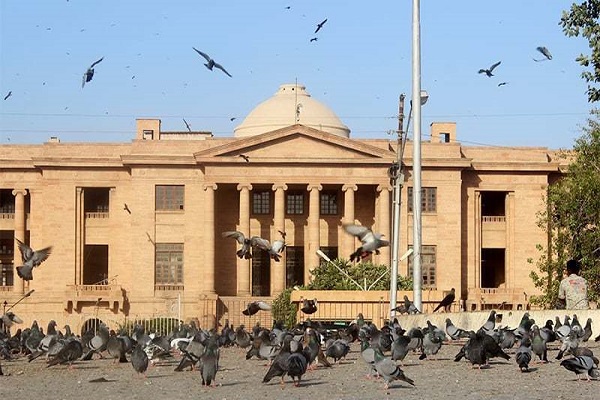
Sindh High Court History
The Sindh Courts-Act (VII-1926) was passed on 21st August 1926 to the ‘Law-Making’ provision for establishing a chief-court for Sindh. When Part-3 of the Indian Govt Act-1935 came into operation on 1st April 1937, Sindh got a separate province’s status. Appointment of judges for the Court of Judicial-Commissioner of Province Sindh was handed over to the British Government.
When West Pakistan’s High-Court was established initially, the strength of judges was Fifteen. When Baluchistan and Sindh High-Courts were separated, twelve judges were appointed in Sindh High-Court, and three judged in Baluchistan High-Court. Currently, the approved number of judges is twenty-eight.
Jurisdiction
H.C. has Supervisory, Civil, and Constitutional Jurisdiction and is bestowed with a practical, comprehensive, and vast jurisdiction. An individual in custody within Court’s territorial jurisdiction may appear before the Court, so it may get satisfied that the individual is held in custody with lawful authority and in a lawful manner.
It requires that an individual who holds the office or intends to hold an office within the territory of the Court should show the law authority under which he claims to have that office.
The High Courts hold the authority to give directions or orders to any person, Government, and authority exercising power or performing functions related to Court jurisdiction or within court territory to enforce fundamental rights bestowed by Constitution.
Supervisory Jurisdiction
H.C. exercises 2-types of the ‘Supervisory Jurisdictions’ including Administrative and Judicial. H.C. control and supervise all the sub-ordinate courts. Judicial supervision is held by hearing and entertaining revisions and appeals against sub-ordinate courts’ judgments/orders. While in Administrative supervision, H.C. inter-alia:
- Post and recruit judicial officials for sub-ordinate courts.
- Ensure the effective and smooth working of sub-ordinate courts by monitoring them.
- Issues instructions and inspects the sub-ordinate criminal and civil courts.
- Make rules for the standardized process and procedure for the effective functioning of courts subordinate to H.C.
- Conducts disciplinary actions including the departmental inquiry
- Complaints filed against Judicial Officials.
- ACR
Civil-Original Jurisdiction
Sindh High Court’s Principal seat has ‘Civil-Original Jurisdiction’ in civil cases that includes admiralty cases and company cases etc., in which a relief claim exceeds Rupees 1.5 Crore. A limit in the Banking affairs, however, exceeds Five crores.
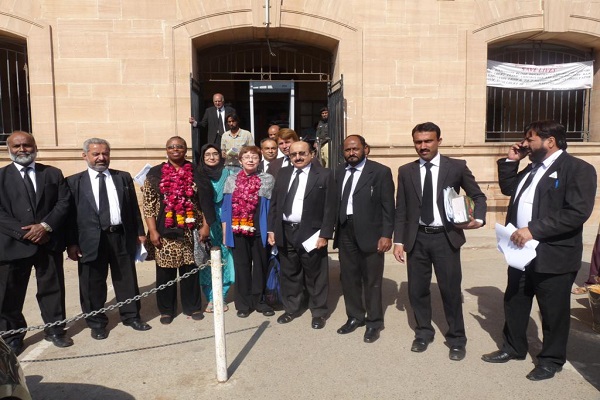
Building Complex
In 1923, the present main-building commenced estimating the expenses to be Rupees 39, 75, 248 but it got completed on 22nd November 1929 at the cost of Rupees 30,35,000. Currently, this building accommodates courtrooms, benches, and chambers of eighteen judges.
Some judges hold legal proceedings in their chambers. The building is also providing accommodation for the offices of Deputy Attorney General, Attorney General, Sindh Advocate General, High-Court Bar Library, Sindh Additional Advocate General, and Sindh Assistant Advocate General.
An Annexe Building was set up on High Court’s North-East side at the expense of Rupees 4.4 Million. This Annexe didn’t provide much ease. It accommodates court offices and gives office-accommodation for the Ministry of Justice & Parliamentary Affairs, Official Assignee, Federal-Shariat Court Registry, Secretary, Sindh Bar Council, and Standing Counsel. So, it would be observed that there is an accommodation shortage.
Bench
Sindh high-court comprises twenty-seven judges and chief justice. After consulting Pakistan Chief Justice, province governor, and high-court chief justice, President appoints the high court judge. Criteria for becoming a high court judge include Pakistani nationality, forty years old, remained High-Court advocate or had held judicial office for 10-years and, or who has worked as District Judge for a minimum of three years.
High court judge holds his position until he becomes sixty-two years old unless he resigns sooner or Constitution removes him from office. The Sindh High Court’s principal seat in Karachi having benches at Larkana, Sukkur, and Hyderabad.
Sindh High Court Judges
Chief-Justice heads the Sindh High Court, and the bench includes additional judges and justices. Retirement age is sixty-years for both justices and chief justice. Initially, the additional-judges are appointed for 1-year, and after a year, their tenure could be confirmed, extended, or may retire. Currently, Justice Ahmad Ali Sheikh is serving as Chief Justice Sindh High-Court.
Current and Former Registrars
Mr. Ghulam Rasool is serving as current registrar of Sindh High Court. Some of the former registrars include Mr. Ashhad Ali, Mr. Wajahat, Mr. Haider, Mr. Ali Muhammad, Mr. Hamid, Mr. Nazim, Mr. Shabeer, Mr. Ghous, Mr. Abdul Ghani, and Mr. Zaheer.
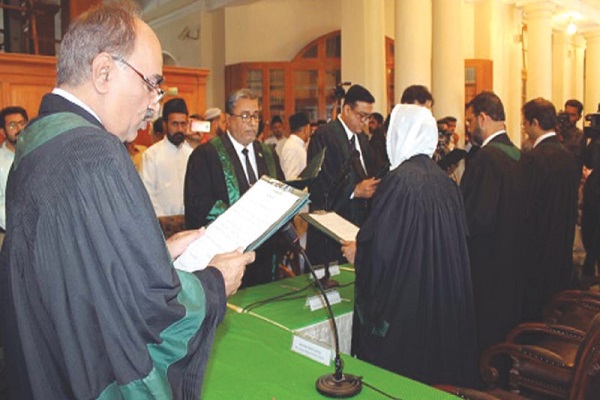
Sitting Judges
Chief Justice Ahmad Ali Sheikh, Puisne Judge Justice Irfan Saadat, Justice Aqeel Ahmad, Justice Nadeem Akhtar, Justice Muhammad Shafi, Justice Hassan Rizvi, Justice Aziz-ur-Rehman, Justice Abdul malik, Justice Zafar Ahmad, Justice Naimatullah, Justice Faheem, Justice Umer Sial and Justice Amjad Ali are some of the sitting judges of Sindh High-Court.
Former Judges
Former judges include Justice Durab, Justice Muhammad Haleem, Justice Abdul Qadir, Justice Ghous Ali, Justice Zafar Hussain, Justice Agha Ali, Justice Abdul Hafeez, Justice G.M Shah, Justice Faisal, Justice Sadiq Hussain, Justice Iqbal, Justice Muneeb, and Justice Khadim Hussein. They served from January 1976-October 2020 at Sindh High Court.
Judges Re-appointment
After the general election and General Pervaiz’s resignation, the People’s Party-led Government made a re-appointment of judges under the Constitution 1973 and took a fresh oath; some judges took the new oath and were re-appointed on the 27th August 2008and on 6th September 2008.
Re-Appointed in Aug 2008
- Anwar Zaheer-Chief Justice
- Ameer Hani
- Khilji Arif
- Sajjad Shah
- Faisal Arab
- Salman Ansari
- Abdul Rasheed
- Zafar Ahmed Khan Sherwani
Re-Appointed on 6th September 2008
- Sarmad Jalal Usmani
- Sabih-ud-din Ahmad
- Muhammad Athar Saeed
- Gulzar Ahmad
Department of Information Technology (I.T.)
I.T. Committee or Automation and Court Technologies of Sindh High Court monitor the automation of Sindh High-Court and all sub-ordinate Sindh Courts.
List of I.T. Chairmen
Justice Muhammad Ali, Justice Ahmad Ali, Justice Sajjad Shah, Justice Faisal, Justice Muneeb Akhtar, Justice Mushir Alam, Justice Shahid Anwar, Justice Sarmad Jalal, Justice Shabir Ahmad, Justice Ahmad Sarwana have served as chairmen of I.T. department of Sindh Court.
Complaint Cell
- For a complaint against any Judicial officer Member of the Inspection Team-I could be contacted at email [email protected].
- For a complaint against the Govt Department or Officer from Overseas Pakistani Nationals Member of Inspection Team-I, it could be contacted [email protected].
- For complaints against the Govt Department/Officer, an Additional member of Inspection Team-II could be contacted at [email protected].
- For criticism and opinions relevant to Sindh Judiciary’s automation Director of I.T. department could be contacted on email [email protected].
Contact Information
Email: www.sindhhighcourt.gov.pk
Fax: (021) 99203221
Phone # (021) 99203151-9
]]>Lawyers sent a proposal to establish new benches of high-court in D.G. Khan, Gujranwala, Sialkot, and Faisalabad, but LHC rejected this demand. This article carries every information about the court, including Lahore High Court History.
| Title | Description |
|---|---|
| Basic Information | |
| Formed: | 1919 |
| Details | |
| Court Name: | Lahore High Court |
| In Urdu: | عدالت عالیہ لاہور |
| Established: | 1919 |
| Location: | Lahore |
| Country: | Pakistan |
| Composition Method: | Presidential with confirmation of Chief Justice of Pakistan and Governor of Punjab. |
| Authorized By: | Constitution of Pakistan |
| Decisions are Appealed to: | Supreme Court of Pakistan |
| Judge Term Length: | Till 62 years of age |
| Number of Positions: | 60 |
| Current Executive: | Hon’ble Chief Justice Muhammad Yawar Ali |
| Since: | 28 June 2016 |
| Lead Position Ends : | 27 November 2024 |
| Website: | http://www.lawsofpakistan.com/ |

Lahore High Court History
The EIC (East India Company) defeated the Empire of Sikh in 1849 and took over Punjab’s administration control. An administration board was formed, and Punjab’s division was done into Tehsils, Districts, and Divisions.
Commissioners took control of Divisions, Deputy Commissioners took control of Districts, and Assistants & extra-assistant commissioners took over Tehsils’ control. Sir Henry, Charles Mansel, and John Lawrence were members of the Administration Board.
Punjab’s LHC Chief Court
Punjab and remaining British India were handed over to the British Crown in 1958, and Queen Victoria was given the authority to make decisions regarding justice and administration. An increasing number of court-cases made it necessary to expand the province’s judicial structure.
The province’s Punjab Courts-Act (XIX-1865) initiated 7-grades of the courts merging administrative and judicial assignments and demanding jurisdiction over criminal and civil cases. Tehsildar Court got the status of ‘Lowest-Court,’ and Judicial Commissioner was granted the status of ‘Highest-Court’ inland.
In 1884 4-classes of courts were made subordinate to Chief-Court, namely ‘District Judge Court,’ ‘Subordinate Judge Court,’ ‘District Judge Court,’ and ‘Munsif Court.’
LHC
Punjab’s Chief Court’s status was raised to a level of ‘Lahore High-Court’ named as LHC (Lahore High-Court). George Frederick was designated as the Chief Justice and announced this court’s jurisdiction over Delhi and Punjab provinces.
Indian Government-Act 1935 eliminated the hurdle that Chief-Justice should be given the status of Barrister-Judge. It made this post available to ‘Civilian-Judges.’ Sixty age was set as a limit for high court judges. Indian Government Order-1937 set a limit for maximum strength of judges in Indian High Courts. For LHC, maximum number was set at Fifteen.
West Pakistan’s High Court
Pakistan’s Constituent Assembly established West Pakistan Province on 30th September 1995 and granted Governor-General authority to create High Court of West Pakistan founded in 1956. Sindh Chief Court’s judges & Peshawar Judicial-Commissioners Court became West Pakistan High Court’s judges.
Divisional Benches Establishment
Lahore High Court was authorized to establish benches at Rawalpindi, Multan, and Bahawalpur. Judges of LHC were also given the authority to form circuit-courts at any location in the province, having judges recommended by the Chief Justice of LHC.

LHC Chief Justice
In 1880 Sir Henry Plowden was 1st Chief Justice, and currently, Qasim Khan is serving as chief justice since 19th March 2020.
Administration
Rawalpindi Bench
- Mr. Ghafar Mehtab-Senior Additional Registrar
- Mr.Usman Shahid-Deputy Registrar
- Mr.Abdul Hafeez-Additional Registrar
Multan Bench
- Mr. Muhammad Walana-Senior Additional Registrar
- Mr. Muhammad Irfan-Deputy Registrar
- Muhammad Zahoor Hussein-Deputy Registrar
- Mr. Muhammad Shahid-Additional Registrar
- Mr. Naseem-Deputy Registrar
- Mr. Muhammad Shehbaz-Deputy Registrar
Bahawalpur Bench
- Mr. Khalid Mehmood-Senior Additional registrar
- Mr. Muhammad Maqsood-Deputy Registrar
- Mr. Nasarullah-Deputy Registrar
- Mr. Muhammad Sarwar-Additional Registrar
- Mr. Shahid Naseer-Deputy Registrar
Court Hours (Benches & Principal Seat)
Monday-Thursday
- Court Sittings 09:00 am-11:30 am
- Interval 11:30 AM-12:00 PM
- Court Sittings 12:00 pm-2:30 pm
Friday
- Court Sittings 09:00 am-11:30 am
- Interval 11:30 AM-12:00 PM
- Court Sittings 12:00 pm-01:00 Noon
Saturday
Saturday is not for court-sittings but is reserved for the dictating judgments.
Office Hours
Monday-Thursday & Saturday
- 08:30 AM-04:00 PM (01:00-02:00 PM Break)
Friday
- 08:30 am-01:00 pm

Departments
Research Center
The LHC took a creative step by establishing a ‘Research Center’ to give research assistance to honorable LHC judges. Justice Azmat Saeed, then-Chief Justice of LHC, approved this innovatory idea of Justice Mansoor Shah to establish a research center.
Then-Chief Justice inaugurated this center on 27th January 2012. SOPs were made for assigning job assignments to Research Officers and untroubled functioning of this center. The center has been founded in ‘Judges-Old Library’ located in the basement of High-Court’s building.
The purpose behind housing the research center in the old library was to facilitate research officials to easily access research materials that are law-reporters, law-journals, and books. Net and computer facilities have been provided.
Current Research officers
- Mr. Ahmad Zia
- Mr. Sher Hassan
- Mr. Muhammad Rizwan
- Mr. Shafqat Abbas
- Mr. Hamid-ul-Rehman
- Mr. Kashif Iftikhar
- Mr. Aftab Rana
- Mr. Fakhar Sial
- Mrs. Uzma Zahoor
- Mr. Kashif Pasha
- Ms. Afshan Sidra
NJP Implementation-Cell
‘National Judicial-Policy Implementation Cell’ was founded on 13th November 2012 by LHC to monitor oldest cases’ disposal (filed up to 31st December 2008) that were pending in Punjab District Judiciary. Muhammad Hafeez (District & Session Judge) supervised its establishment.
Ms. Bushra Zaman (Additional District & Sessions Judge) got designated as Monitoring Incharge to monitor oldest cases’ disposal with 3-civil judges Rana Aneel, Muhammad Fayaz, and Talalt Waheed.
Helpline
1134 is the helpline of LHC.
LHC Judges
Sitting Judges
Some of the sitting judges serving at LHC are Muhammad Qasim Khan (Chief Justice), Muhammad Ameer (Senior Puisne Judge), Justice Malik Shehzad, Justice Shujaat, Justice Ayesha, Justice Shahid, Justice Ali, Justice Atir, Justice Shahid, Justice Aalia, Justice Abid, Justice Tariq, Justice Masood, Justice Sadaqat, Justice Shams, Justice Shehbaz, Justice Jameel, Justice Faisal, Justice Mushtaq, Justice Mirza Waqas.
Former Chief Justices
Some of the former Chief Justices are Justice Mamoon, Justice Sardar Muhammad, Justice Anwar-ul -Haq, Justice Yawar, Justice Mansoor Shah, Justice Ijaz, Justice Manzoor, Justice Imtiaz, Justice Azmat, justice Ijaz, Justice Khawaja Shareef, Justice Iftikhar, Justice Falak, Justice Mehboob, Justice Rafique, Justice Aslam, Justice Rasheed, and Justice Qadeer-ud-din.

Former Judges
Some of the former judges are Justice Tasaddaq, Justice Abdul Manan, Justice Shareef, Justice Riaz, Justice Asif, Justice Nasira, Justice Karamat, Justice Rao Naeem, Justice Jahfar, Justice Javaid, Justice Mian Saeed-ur-Rehman, Justice Ghulam, and Justice Mumtaz.
LHC Pay Structure
Pay and Allowances of Chief Justice
- Basic Pay-713,280
- Superior Judicial-Officer Allowance-269,525
- House Rent-67,733
- Medical Allowance-65,000
Pay and Allowances of Judges
- Basic Pay-685,847
- Superior Judicial-Officer Allowance-269,525
- House Rent-65,000
- Medical Allowance-65,128
Privileges to the Sitting-Judges
- Official Car- 500 L Petrol/ Month
- Garden Charges-Rupees 25000/Annum
- Contingent Staff- Rupees 25000/Month
- Utility Bills-Unlimited
- Generator-22KV with max 4.5 L fuel/hours for five hours/day
Contact Information
- Lahore High Court Shahrah-e-Quaid -e-Azam Lahore Pakistan
- Phone # +92 42 99212951 – 66
| Title | Description |
|---|---|
| Basic Information | |
| Formed: | 2010 |
| Details | |
| Court Name: | Islamabad High Court |
| In Urdu: | اسلام آباد ہائی کورٹ |
| Established: | 2010 |
| Location: | Islamabad |
| Country : | Pakistan |
| Composition Method: | Presidential with confirmation of Chief Justice of Pakistan and Governor of Sindh. |
| Authorized By: | Constitution of Pakistan |
| Decisions are Appealed to: | Supreme Court of Pakistan |
| Judge Term Length: | Till 62 years of age |
| Number of Positions: | 7 |
| Current Executive: | Mr. Justice Muhammad Anwar Khan Kasi |
| Since: | 25-02-2013 |
| Website: | http://www.ihc.gov.pk/ |

Islamabad High Court History
Pervaiz Musharraf, a military rule, ordered the establishment of Islamabad High Court, and his order was fulfilled on 14th Aug 2007. Pakistan Supreme Court ceased this Court’s existence on 31st July 2009 following Constitution’s Petition Number Nine and Eight of 2009.
Islamabad High-Court Act 2010 re-established the High Court following the eighteenth amendment to Pakistan’s Constitution. Iqbal Hameed took oath as 1st Chief Justice of High Court on 3rd Jan 20111 under the administration of then-President Asif Ali Zardari at Governor-House.
Current Composition
Chief Justice heads the Islamabad High- Court, and there are 6-justices & additional judges on the bench. The retirement age of justices and the chief justice is sixty-two years. Initially, the appointment of additional judges was made for a one-year duration.
After one year, they could be retired or confirmed, or their tenure could be extended. Following is the current composition of the Islamabad High-Court.
- Athar Minallah-Chief Justice
- Amir Farooq-Additional Judge
- Miangul Hassan-Additional Judge
- Lubna Saleem-Additional Judge
- Fiyaz Ahmad- Additional Judge
- Ghulam Azam- Additional Judge
Inspection Team
The member Inspection Team (MIT) was made in 2011 to monitor and check judges’ performance in District-Judiciary under Inspection Judge/ Chief Justice’s visionary supervision.
Following are the powers, functions & duties of MIT:
- To monitor the subordinate judiciary performance on a weekly, monthly, fortnightly, and quarterly basis.
- To check the work of judicial-officials in specific & sub-ordinate judiciary in general and also the para-legal staff.
- To monitor sub-ordinate courts randomly and in Chief Justice’s directions.
- To comply and perform the directions or tasks assigned by Chief Justice or any other judge of High-Court.
- To process and entertain complaints and applications of all types.
- Observe and realize bottlenecks, system & procedure weaknesses, and recommendations for eradicating these weaknesses and present these recommendations before Administration-Committee or Chief Justice.
IHC Library
In 2008 IHC library was established to fulfill the needs of staff and judges of the Court. There were three-thousand books at the start, but with quick advancement of knowledge, the number of books was increased to 12,500 books until 2010.

Achievements of IHC
IHC-Automation
The mandatory use of IT (Information Technology) can’t be denied in this modern era. Courts are also accepting miraculous and splendid inventions of IT. Chief Justice keenly takes an interest in the automation of court activities in IHC. His interests have led to rapid development in this field. The progress made during the past years is as under:
Revamping of the website of IHC
IHC had launched a new website according to International standards & is based upon new technology. This website is completely compatible with every screen type, and its purpose is to facilitate all lawyers, stake-holders, and litigants.
Key features of this website are:
- Roster
- Orders/Judgements
- Downloads & Archives
- Judges, Officers & Administration’s Information
- IHC Library Catalog
- Announcements & News
- District Judiciary’s Information
- Feedback, Organization Chart, and Officers’ list
- Notifications and Advertisements
Networking
Earlier, IHC had no network-infrastructure, but now with the assistance of a greater number of the nodes Department of Information Technology has set up a server-based network. Now there is a connection between all the courts and benches via a centralized database system.
Software Upgradation
Initially, there was a CCIS Software (Current Case Information System). Still, the IT department has now developed the new software CFMS (Case Flow Management System) that includes CLMS (Case Law Management System), Case-Fixation, and OCP (Online Court Proceedings).
Case Record-Management System
A new software entitled ‘Case Record-Management System’ has been launched to keep computerized information of all decided cases in record branch.
Public Information Desk
The purpose behind this desk’s establishment is to facilitate lawyer groups and the litigant public to access information relating to hearings and case fixation.

Copy Petitions-Management System
This software was launched and utilized to maintain and save the information relating to daily progress-report, case searching, copy petitions, pendency, daily register, and disposal register.
Biometric System of Attendance
Biometric System of Attendance has been implemented in IHC for employees and staff.
Communication Technology
Tools relating to communication technology like text messages and electronic mail have been implemented to speed-up information delivery both inside and outside the organization.
New Automation Initiatives
Human Resource-Management System
IHC’s IT department has developed a Human Resource-Management System, and its features are:
- Performance Appraisal
- Attendance & Time
- Scheduling
- Analytics
- Absence Management
- Educational History
- Employment History
- Disciplinary Actions
- Performance Record
- Posting Transfers & Entire Official Information
- Recruiting Management
Identity Section
The latest setup for the identity of the Petitioner aimed at filing an ‘E-Affidavit’ would be verified via impression of thumb on the Biometric system installed by the Court’s programmer.
IHC Mobile Application
The IT department of IHC has developed and designed an application for Court. This app aims to spread information related to all cases filed in IHC or Session & District Courts. This app is available on Google Play Store.
Facilities
Issuance of Fitness Certificates to Lawyers
Fitness Certificates have been issued to several lawyers for their enrolment as Pakistan Supreme Court’s advocate by the ‘Honorable Committee’ of the Court.
Facilities of Bar Room
On a priority basis, sufficient space is provided to Bar members for the library, office rooms, counseling rooms for the public, and canteen.

Timings of Court
Monday-Thursday
09:00 am-02:30 pm
Friday
09:00 am-12:00 pm
Office Timings
Monday-Thursday & Saturday
08:30 am-03:30 am
Friday
08:30 am-03:30 pm
Timings of District Court
Monday-Thursday
08:30 am-03:30 pm
Friday
08:30 am-12:00 pm
Contact Information
Address: Bela Road, Sector G-10/1, Islamabad, Pakistan.
Exchange: +92 51 9108171-2
E-mail: [email protected]
Website: www.ihc.gov.pk
| Title | Description |
|---|---|
| Basic Information | |
| Formed: | 14 August 1947 (radio) |
| In English: | Radio Pakistan |
| In Urdu: | ریڈیو پاکستان |
| Type: | Federal Corporation |
| Industry: | Mass media ,Public broadcasting, Radio network ,Television network |
| Headquarters: | National Broadcasting House G-5/2, Islamabad, Capital Territory, Pakistan 44000 |
| Area served: | National; available on terrestrial and cable systems |
| Key People: | Marriyum Orangzaib (Minister of Information & Broadcasting) |
| Products: | Broadcasting, Radio, Television |
| Services: | Radio Pakistan, PTV Bolan, PTV Global ,PTV Home ,PTV National, PTV News, PTV Sports, PTV World ,AJK TV |
| Owner: | Government of Pakistan |
| Website: | http://radio.gov.pk/ |

Radio Pakistan History
At the time of its establishment on 14th August 1947, Radio-Pakistan was named ‘Pakistan Broadcasting Service.’ It announced the Independence of Pakistan from Britain on 13th August 1947 at 11:59 pm.
Mustafa Ali declared Lahore’s independence in English and Urdu, while Abdullah Jan announced this news from Peshawar in the Pashto language.
Languages of Radio Broadcasts
Radio Pakistan delivers its broadcasts in Thirty-Four dialects, including Bengali, Arabic, Turkish, Russian, Nepali, Sinhala, Tamil, Gujarati, Hindi, Persian, Dari, Chinese, English, Brahvi, Hazargi, Wakhi, Shina, Balti, Burushaski, Gojri, Kashmiri, Khowar, Kohistani, Hindko, Pashto, Potowari, Seraiki, Baluchi, Sindhi, Punjabi, and Urdu.
Establishment of New Stations
According to Agha Nasir, Radio Pakistan’s pioneer at the time of Pakistan’s independence on 14th August 1947, there were 3-radio stations in Dhaka, Peshawar, and Radio. No radio station existed in Karachi at Independence time. But it was then prioritized to establish a radio station in Rawalpindi and Karachi in 1948.
A new Broadcasting-House was opened in 1950 in Karachi; following it, new stations were set up in Rawalpindi (1960), Quetta (1956), and Hyderabad (1951). In 1970 a station was set up in Multan, and training amenities were started in 1970.
PCB Regulation by Zulfiqar Ali
Then-President Zulfiqar Ali Bhutto signed a law to regulate PBC (Pakistan Broadcasting-Corporation) to ‘regulate, distribute, circulate, and publish information and news in all parts of the world in a way that seems fit.’
Radio Pakistan Mission
Its core-mission is ‘Information, News, and Education to be delivered to awareness of the public the complete range of a significant activity.’

Conversion to PBC
On 20th December 1972, Radio Pakistan was turned into PBC as a lawful entity governed by Director-General and Directors Board. On 21st April 1973, Radio Pakistan’s World-Service was initiated, and this service reached Pakistan’s remotest areas having stations at Turbat, Skardu, Gilgit, Far Southwest, and the Far North.
Opening of a New Broadcasting-House
From 1981-1982 transmitters and stations were also set up at Faisalabad, Khuzdar, Dera Ismail Khan. On 7th May 1986 new broadcasting-house was established in Khairpur, following which relay stations were established at Sibi in 1989 on 21st March 1991 and in Abbottabad on 21st March 1991.
Computerization of PBC
Pakistan’s remote areas started receiving coverage after establishing new stations opened at Zhob, Loralai, and Chitral in the 1990s. Federal Information Minister inaugurated PBC’s news processing setup and displayed news bulletins on the internet in audio and text forms.
FM-101
PBC’s channel FM-101 was initiated on 1st October 1998 with stations at Lahore, Islamabad, and Karachi, and now FM-101 has 9-stations in Pakistan and is Pakistan’s largest Radio-network.
FM Transmission
In Oct 1998, Radio-Pakistan began ‘FM Transmission,’ and from 2002 to 2005, new FM-Stations was established at Mithi, Bannu, Kohat, Sargodha, Mianwali, Gwadar, and Islamabad.
Launch of NBS
PBC launched 3-new networks, and on 28th August 2008, Pakistan Broadcasting Corporation launched NBS (National Broadcasting Service), the 1st dedicated channel on Current Affairs. NBS is the combination of Five AM-Transmitters connected for broadcasting the single local program broadcasted across the country.

Karachi, Quetta, Lahore, Peshawar, and Islamabad are primary stations creating national-programming, and it’s seventeen hours of programming on significant International and National affairs, cultural and literary programs.
Launch of FM-93
After the Conference of Station Directors in 2009, PBC initiated a new FM channel, FM-93 having Twenty-Two stations all over Pakistan.
The radio stations at Gwadar, Karachi, Mithi, Hyderabad, Bhut Shah, Khairpur, Larkana, Multan, Lahore, Faisalabad, Mianwali, Sargodha, D.I Khan, Kohat, Bannu, Chitral, Abbottabad, Mirpur, Muzaffarabad, and Gilgit broadcast transmission of FM-93.
Launch of the Planet 94
On 14th November, PBC started its 1st Channel for English-Music in Islamabad named ‘Planet-94.’ This network is operated on ‘FM-94.’ The 2nd & 3rd stations of English-Channel would soon start transmission from Karachi and Lahore.
The peak of Radio Pakistan
From mid-50s-mid 60s ‘Radio Pakistan’ was at the peak of its popularity and success, not only because of lack of a competitive-medium or education, entertainment, and information source but also because of its smooth and perfect working with its standards matching with International Radio-Services.
Radio Pakistan Channels
Current Affairs and News Channel
PBC launched Current Affairs and News Channel in Nov 2000 and was turned into NBS in 2008. It transmits Thirteen-hours programs from 08:00 am-09:00 pm from Islamabad daily and Eight hours from Provincial-Headquarters. Frequencies:
- 3999.75 MHz on Satellite Pak Sat1R
- Peshawar 1170 kHz
- Quetta 756 kHz
- Karachi 639 kHz
- Lahore 1332 kHz
- Islamabad 1152 kHz
FM-101
It is the commercial radio-station 1st aired in 1998.
Other Channels
- Dhanak FM-94
- Central Production Unit
- FM-93
Social Media Handles
]]>According to principles described in the Pakistani Constitution, ECP makes arrangements as required to make sure that the electoral process is conducted justly, honestly, and fairly according to law, and corrupt practices aren’t observed. This article contains all the information about it, including the Election Commission of Pakistan Introduction.
| Title | Description |
|---|---|
| Basic Information | |
| Formed: | March 23, 1956; 61 years ago |
| Phone #: | 042- 99211015 |
| PEC Balochistan: | Mr. Naeem Majeed Jafar |
| Phone #: | 081- 9202334 |
| PEC Sindh: | Mr. Muhammad Yousaf Khan Khattak |
| Phone #: | 021- 99203385 |
| PEC Khyber Pakhtunkhwa: | Pir Maqbool Ahmed |
| Phone #: | 091- 9211036 |
| Website: | https://www.ecp.gov.pk/default.aspx |
| Preceding: | Constitution of Pakistan |
| Jurisdiction: | Constitution of Pakistan |
| Headquarters: | Islamabad Capital Venue |
| Motto: | ان تودوا الامنٰت الىٰ اهلها |
| Chief election commissioner: | Sardar Muhammad Raza Khan |
| Secretary election commission: | Babar Yaqoob Fateh Muhammad |
| Under: | Government of Pakistan |
| Last election: | 11 May 2013 |
| PEC Punjab: | Mr. Shafiullah |

Election Commission of Pakistan Introduction
The ECP was set up on 23rd March 1956. It has been reformed and reconstructed many times in Pakistan’s history. The Chief Election Commissioner (CEC) and 4-retired judges of Pakistani High-Courts from all four provinces KPK, Baluchistan, Sindh, and Punjab, constitute the ECP panel 5-members.
Sikander Sultan Raja is serving as the current CEC. General Elections of 2018 were conducted under the 2017 Elections Act; the National Assembly of Pakistan passed this act on 2nd October 2017. Federal Secretary of ECP, a 22-grade officer, heads the ECP bureaucracy and manages the Secretariat of ECP.
Duties & Functions
Pakistan’s Constitution has set and defined the duties and functions of ECP in Article 219, that charges this Commission with the following functions:
- To prepare the poll book for elections to Provincial & National Assemblies and annual revision of these rolls.
- To conduct and organize an election to the Pakistani senate and occupy vacancies in Provincial Assembly or House.
- To conduct and organize an election to Local Govt Institutes.
- To appoint the Election-Tribunals
- To conduct an election to President’s office as per the 2nd schedule to Pakistan’s Constitution.
- To arrange a Referendum when directed by Pakistan’s President.
- To take decisions about disqualification of Provincial and Parliament Assemblies’ members under Article 63 (A) & 63 (2) of Pakistan’s Constitution on receiving a reference from head or chairperson of Political Party.
According to Article 239G, for each general election to National Assembly and Provincial Assemblies (KPK, Baluchistan, Sindh, and Punjab), an Election-Commission should be formed, and it should be the responsibility of that Commission to conduct and organize an election.
Independence & Autonomy
The Commission enjoys complete independence and autonomy from all Govt control. It is allowed to perform its duties and conduct general elections without any governmental interference. The Commission is assigned to prepare electoral-rolls, appoint polling-personnel, make arrangements for maintenance of law & order.
In the case Javaid Hashmi vs. Election Commission, Pakistan Supreme Court stated that in matters of elections, the Election-Tribunals appointed by CEC exhibit exclusive jurisdiction & dominion of all Pakistani courts; these matters were ruled out.
However, this is an exception when the aggrieved party has no legal solution during or after the electoral process and is against the election functionary’s order outside the jurisdiction, which results in the deprivation of a contestant. In such a case, the contestant can press into High-Court’s Constitutional jurisdiction. Since then Pakistan Supreme Court has followed this decision/judgment.

Judicial Review
The judicial review of the Election Commission’s decisions could be sought out in the Pakistani High Court and Supreme Court if the order faces jurisdictional defect or is in bad faith, or is taken without a judge.
Budget & Expenditure
The federal govt provides a budget of ECP, and CEC can re-appropriate the budget without giving details to Finance-Division. The Finance-Division, according to the needs of ECP, provides funds for making poll books and for conducting By-Elections and General-Elections. After approval of CEC, further funds are distributed to several functionaries.
Election Commission of Pakistan Members
List of Members
- Sikander Sultan-Chief Election Commissioner
- Nisar Ahmad-Member (Sindh)
- Justice Ms. Irhsad Qaisar (R)-Member (KPK)
- Justice Altaf Ibraheem Qureshi (R)- (Member (Punjab)
- Shah Muhammad Jatoi-Member (Baluchistan)
List of Officers
- Sajjad Hussain-Deputy Director
- Waseem Ahmad-Deputy Director
- Gulraiz Abbas Rizvi-Deputy Director
- Babar Malik-Director
- Shamshad Khan-Additional Director-General (Public Relations), Additional Director-General (legal), and Additional Director-General (Monitoring & Admin)
- Khizar Aziz-Director General (I.T)
- Muhammad Arshad-Director-General (Law)
- Javaid Iqbal-Additional Director-General (Budget)
- Shamshad Khan-Director-General Administration
- Akhtar Nazeer-Secretary ECP

Provincial Election Commissioners
- Aijaz Anwar-Sindh
- Ghulam Israr-Baluchistan
- Saeed Gul-Punjab
- Shareefullah-KPK
Contact Information
ECP Secretariat Islamabad
Address: Election Commission of Pakistan Secretariat, Election House, Constitution Avenue, G-5/2 Islamabad
Office Telephone: (+92) (52) (9205611), Fax: (+92) (51) (9205300)
]]>NAT is for students who want to take admission in universities and colleges, while GAT is for students who wish to enroll in postgraduate education. NTS examinations are also conducted to assess the qualifications of those students who seek admission in foreign institutes.
This article contains all the information about the test, including National Testing Service History.
| Title | Description |
|---|---|
| Basic Information | |
| Formed: | 2006 |
| Headquartered: | Islamabad |
| Products: | NAT, General Subject Tests, and General Assessment Test |
| Services: | Testing National Aptitude, Measurement of knowledge base and skill level, Services for Test Preparation, Administrative Services, Admission Test Services for Institutions, Services for Online Testing, Establishing Performance Ranking, Services for Score Reporting, Services to Facilitate Unemployed |
| Website: | http://nts.org.pk/ |
| Fax #: | (92-51) 9258480 |
| Islamabad: | 051-9258478-79 |
| Lahore: | 042-99239258 |
| Karachi: | 021-35215013 |
| Peshawar: | 091- 9218233 |
| Postal address: | National Testing Service (NTS) House # 402, Street # 34, I-8/2, Islamabad. |

National Testing Service Introduction
NTS is a member of IAEA (International-Association for Educational Assessment). It is recognized by the HEC (Higher Education Commission). The primary purpose behind its development was to assure quality standards of education in Pakistan and the provision of a national-scale for the comparative grading between institutions, merging boards of examinations under the one administrating-body.
According to Shahid Siddique, the Director of ‘Center for Humanities & Social-Sciences’ at LSE (Lahore School of Economics), tests conducted before NTS development received criticism for not adjusting the socio-cultural dissimilarities leading to the need for the development of a native testing service that would develop and design testing contents within an indigenous-context.
Renowned Pakistani Institutes such as C.U. (Comsats University), BZU (Bahauddin Zakariya University), BUITEMS (Baluchistan University of Information Technology, Engineering & Management Services), CASE (Center for Advanced Studies in Engineering), and IUB (The Islamia University of Bahawalpur) have made clearing NTS mandatory for the students aiming to enroll at these institutes.
National Testing Service History
In 2007, controversy erupted following NTS’s mandating, 1st announced by Punjab Governor Muhammad Danish regarding admissions in university. The later government set it aside unless amendments were made in laws related to entry into the university.
This testing service received criticism that it was expensive and difficult to access. Maqbool asked for the input from on 4th June from Vice-Chancellors of public universities in Punjab. That year every university got permission to make its admission requirements, and six departments of Punjab University were elected to use tests from National Testing Service.
Haroon Rasheed, the NTS director, stated that no tuition-centers are linked with service, and items of NTS exams wouldn’t be out of course.
Vision
An internationally accepted assessment and testing organization accelerating in generating educated & market-competitive human resources.
Mission
To promote and build standards in professional and educational assessment.
NTS Policy and Standards
Policy
- Quality Management
- International Standards-Testing
NTS has adopted a zero-tolerance policy in conducting assessments and tests
Standards
- Merit
- Reliability
- Transparency
- Fairness
Legal-Structure
Academic & Other Committees
NTS has made the following committees that consist of the experts:
Academic Committee: consists of renowned professors of the university responsible for curriculum development and promoting and regulating consistent testing.
Executive Committee: Consists of all nominees and HODs that supervise operational matters of the NTS.
Peer-Review Committee: Comprises eminent and well-known professors of the university responsible for affirming test items and test contents.
MCQ Contributors-Committee: comprises of the educational-experts from the primary-level to professional-level, faculty personnel from colleges & universities, who assist in making authentic Tests.
Subject Committee: makes curriculum standards to promote and regulate testing standards in a particular subject; several test-item developers work under Subject Committee.

NTS Management
Mr. Tahir Aqeel is serving as CEO, and Mr. Muhammad Siddique is Company Secretary of NTS.
Institutional-Capacity & Network
- Two-Hundred and Fifty full-time workers
- Ten-Thousand highly-trained staff for test invigilation
- Capable of conducting the test for Three lac candidates in sixty-eight cities and computerized tests in forty-five Pakistani cities simultaneously
- Capable of processing one lac application forms/day.
- Three-Hundred and fifty institutes are on the NTS panel as test centers.
- Almost Three-Thousand contributors to test items are from renowned universities and well-recognized professional institutes.
- Test Item-Bank consists of over Six lac test items in almost seventy-seven renowned Social-Sciences & Natural Sciences, Management, MedicineI.T.IT, and Engineering disciplines.
Progress & Achievements
The testing service has conducted over Seven-Thousand one-hundred and seventy-one assessments and tests in several disciplines for promotion, recruitment, review, and education. Over Twenty Million contestants from partner organizations and institutions and reputable associates have appeared in National Testing Service since its formation (till June 2018).
NTS Impact
- A culture of transparency and testing has been fostered. Resulting in many new institutes for assessment and testing are emerging in Pakistan.
- NTS Tests are accepted and recognized at both International and National levels.
- These Tests have enabled a large number of students in Pakistan to pursue Ph.D. scholarships in institutes in the USA, Europe, China, Canada, and Australia.
- NTS assessments have assisted in the improvement of Pakistan GCI ranking on the fifth pillar-The Higher Education & Training-Tertiary Education 121 from 125 in 2012 to 2013
Divisions
Coordination & Operation Divisions
It is responsible for recognizing new future-markets, coordinating with clients, and marketing the NTS products. A significant part of the coordination-activities includes coordinating with the district officials for the well-ordered flow of operations during tests.
Operation
NTS is an organization that has multiple activities, so it functions under well-thought SOPs (Standard Operating Procedures) to assure professionalism in its activities and to improve success chances of every activity.
This department performs all functions such as Registration Process of the Candidate, Selection Process of Test Center, Paper-Checking Process, Invigilation Process, Process of Test Preparation, & many more.
Quality Assurance
This testing service arranges both paper-based and online tests. SOPs are strictly followed to ensure this complete system’s credibility, accuracy, reliability, and efficiency.
Corporate-Social Responsibility
NTS has made this Division called CSR (Corporate Social Responsibility) to support and help efforts in easing the socio-economic situation of the under-privileged & make the country a developed-economy.
The CSR’s core objectives and aims are:
- To support the Welfare Fund of the NTS Employees.
- To extend the scholarships.
- To support exhibitions, conferences, meetings, and programs that have objectives according to Mission OF NTS.

The Beneficiaries include
- Educational Institutes
- NTS employees & their spouse
- Deserving & Under-Privileged students
International-Collaboration & Accreditation Division
This NTS division was formed in Oct 2014 to develop networking, linkages, collaborate, and cooperate with educational institutes and international organizations involved in developing assessment and testing procedures, imparting training, education, research & development, and capacity-building. This Division comprises of the following two departments:
- NTS-ETS Project
- Office of Development
Services & Corporate-Affairs Division
This Division aims to facilitate the seamless and smooth working of this overall organization for achieving its higher-objectives. This Division consists of the following departments:
- Corporate Affairs
- Administration
- Human Resource
- Audit and Accounts
Universities Associated with NTS
Some of the universities associated with NTS are:
- Kinnaird College for Women in Lahore
- CASE (Center for Advanced Studies in Engineering)
- Kohat University of Science and Technology
- COMSATS University in Islamabad
- Pakistan Atomic Energy Commission
- National Textile University in Faisalabad
- NAMAL College in Mianwali
- The National University of Computer and Emerging Sciences
- Karachi Institute of Technology and Entrepreneurship
- Islamia University Bahawalpur
- International Islamic University in Islamabad
- University of Gujrat
- Institute of Space Technology in Islamabad
- University of Science and Technology in Bannu
- Institute of Southern Punjab in Multan
- University of Loralai
- University of Swat
- Gomal University iD.I.I. Khan
- GIFT University in Gujranwala
- Fatima Jinnah Women University in Rawalpindi
National Testing Service Services
NTS experts offer teachers’ training, capacity-building, technical assistance, and consulting services and provide solutions to government & private organizations and institutes throughout the country. NTS could meet the needs of its partners in these ways:
- Assess knowledge & skill levels
- Establishing performance-ranking
- Test preparation; an entire guideline for preparation of test
- Action-oriented research
- Project design, Identification, evaluation, and monitoring
- Impact assessment-studies
- Reporting/ Documentation
- Score reporting
- Baseline surveys
- Strategic planning
- Training of the teachers & and professional development
Future Products
With its dynamic and visionary leadership & committed personnel, this testing service is extending the scope of its subjects & test categories. Following are future products of NTS:
Vocabulary, Syntax & Logic-Evaluation
NTS employs a computer-application named ‘NTS E-rater’ for evaluating essay questions to mark answers based on syntax, vocabulary & logic.
Verbal & Mathematical-Skills Tests
NTS is forming new products for several levels, from primary to higher education, that would assess mathematical and verbal skills.
English Language-Proficiency Tests
NTS is striving to form testing products to evaluate English skills for students/individuals seeking admission or employment abroad. These tests would have similar patterns as TOEFL and IELTS.
Vision 2025
Ten years of plan ‘Vision 2025’ of NTS is based on past experiences & future demands of the market. It is striving to reach ten million direct-beneficiaries by 2025. During this 10-year plan, this program would focus on:
- T&A-Testing and Assessment
- ICB-Institutional Capacity Building
- NPB-Network & Partnership Building
- RIC-Regional & International Cooperation
- IKM-Information & Knowledge Management
Contact Information
Phone Number: +92-51-844-444-1
For Queries: [email protected]
Website: www.nts.org.pk
Address: Plot Number 96, Street Number 4, H-8/1, Islamabad.
]]>The PAEC actively cooperates with CERN (European Organization for Nuclear Research) to research particle physics, providing financial contributions and human capital. The commission arranges conferences and supervises research activities at renowned institutes in Pakistan. This article contains all the information including Pakistan Atomic Energy Commission Introduction.
| Title | Description |
|---|---|
| Basic Information | |
| Formed: | March 1956 |
| Name: | Pakistan Atomic Energy Commission |
| In Urdu: | ادارہ جوہری توانائی پاکستان |
| Superseding : | Pakistan Nuclear Regulatory |
| Agency: | Authority (PNRA) National Command Authority (NCA) |
| Jurisdiction : | Government of Pakistan |
| Headquarters : | Islamabad, Islamabad Capital Territory |
| Agency Executive : | Muhammad Naeem, Chairman |
| Research and Development of: | Nuclear Power, Promotion of Nuclear Science, Energy Conservation, Nuclear Technology |
| Integrated with: | National Command Authority |
| Now Under: | Prime Minister Shahid Khaqan Abbasi |
| Power Plants Energy Production: | The capacity of ~8800MW by 2030 |
| Power Plants: | Kanupp Chashnup |
| Chairman: | Muhammad Naeem |
| PAEC Member : | Aslam Hayat Bhatti, Mr Jamal Ud Din Ahmad, Mr Mansoor Ali Sheikh, Mr Tariq Mahmud |
| Finance Secretary MOF: | Mr Mansoor Ali Sheikh |
| Website: | http://www.paec.gov.pk/index.aspx |

Pakistan Atomic Energy Commission Introduction
Since its foundation in 1956, the energy commission has looked after nuclear infrastructure’s substantial development to support Pakistan’s economic uplift by establishing institutes that concentrate on nuclear-medicine radiation treatment to cure cancer and food irradiation.
The energy commission is also a sponsor and research partner of CERN (European Organization for Nuclear Research). Competent scientists of Pakistan have played their part in developing particle-accelerators and conducting research on particle Physics. Scientists working in PAEC regularly visit CERN while carrying out projects of CERN.
The energy commission worked as a civilian-federal oversight institute until 2001 and manifested nuclear weapons development and control of the atomic radiation. Later National Command Authority and NRA (Nuclear Regulatory Authority) took control of these functions under PM Pakistan.
Early History
After the British-Indian Empire’s partition by the U.K in 1947, Pakistan became a Muslim state. The establishment of PCSIR (Council of Scientific & Industrial Research) in 1951 started research on ‘Physical Sciences.’ David Dwight, the U.S. President, announced a program, ‘Atoms for Peace’ in 1953, and Pakistan became the earliest partner of this program.
The Pakistani Govt set up a scientists committee in 1955 to make plans for nuclear energy and built an atomic infrastructure at the industrial level throughout Pakistan.
Establishment of PAEC
After implementing the Energy-Council Act, the PM Huseyn Suhrawardy set up PAEC (Pakistan Atomic Energy Commission) in March 1956. Firstly, an experimental physicist Nazir Ahmed chaired this commission. Other PAEC members were Saleem-uz-Zaman Siddique, an organic chemist at UoK (University of Karachi), and a mathematical physicist Razi-ud-Din Siddique.
Both these experts held charge of the development and research directorates of this commission. Abdus Salam of Punjab University and Muneer Ahmed joined the energy commission in 1958, who initially demanded getting a swimming pool reactor from the USA.

Establishment of Heavy-Water Facility
Chairman PAEC Nazeer Ahmed proposed in 1958 to PIDC (Pakistan Industrial Development Corporation) to establish a heavy-water production facility to produce fifty kg heavy-water/day at city Multan. Still, the proposal wasn’t brought into action.
Ishrat Hussein Usmani took control of PAEC as its 2nd chairperson after Nazeer Ahmed’s transfer at PBS (Pakistan Bureau of Statistics).
Establishment of PINSTECH
PAEC founded its 1st research institution in 1964, the PINSTECH (Pakistan Institute of Nuclear Science & Technology) at Nilore, and started a dialogue for 1st commercial nuclear power plant of Pakistan to be established in Karachi.
Agreement with CGE
The PAEC agreed in 1965 with CGE (Canadian General Electric) to establish a CANDU reactor in Karachi. ECC (Economic Coordination Committee) made financial investments for KANUPP (Karachi Nuclear Power Plant), and an America based architect Edward Durell was employed to supervise the architectural pattern of PINSTECH.
Uranium Discovery
The energy commission sent six-hundred scientists abroad for receiving nuclear sciences training. PAEC announced uranium discovery in 1973 in Punjab.
Creation of Nuclear Weapons
After India’s victory in the 1971 Indo-Pak War, Pakistan withdrew its ‘non-weapon’ policy. In 1972 Pakistan began to research and creation of nuclear weapons. PM Zulfiqar Bhutto named Muneer Ahmed, the atomic engineer, as 3rd chairperson of PAEC.
In the 1970s, work started on developing nuclear fuel chain infrastructure. Scientists started research on weapon-designs at PINSTECH and eventually testing of atomic weapons. In 1976 PAEC decided on possible sites for testing weapons, and in 1979 site construction got completed.
PAEC’s struggles bore fruit in 1983 when it carried out 1st subcritical testing of weapon design, and this testing extended until the 1990s with the codename ‘Kiarna-I.’
Research & Education
Since its foundation, PAEC had provided remarkable examples of atomic era technologies’ advantages for the progress of biology, agriculture, medicine, and engineering. The PAEC founded its 1st centre of nuclear medicine to treat cancer at JMC (Jinnah Medical College) of Karachi University.
At Mayo Hospital of KEMU (King Edward Medical University), the 2nd medical Isotope Institution was set up. The PAEC founded its atomic research facility in Lahore and established a metallurgy centre in 1963 in Karachi.

Establishment of PIEAS
PAEC established PIEAS (Pakistan Institute of Engineering & Applied Sciences) ranked among the country’s primary technical institutes, and many engineers and scientists from PAEC served in this institute.
PAEC Contributions to INSC and ICTP
The PAEC supports the Physics program at GCU (Government College University) Lahore and awards fellowships to its students. Presently, PAEC maintains its image as a prestigious institute and is considered among the most extensive science & technology institutes.
It supports learning programs and research activities at ICTP (International Center for Theoretical Physics). The PAEC is serving as sponsor and organizer of INSC (Intl Nathiagali Summer College on Physics & Contemporary Needs) conference every year.
Scientists from all parts of the world attend this conference. This college spread knowledge of Logic, Philosophy, Computer Science, Mathematics, Astronomy, Biology, Chemistry, and Physics.
Studies and Research on Nuclear Power Expansion
PAEC is responsible for the proper functioning and design preparation of nuclear power plants in Pakistan. It lobbies at the government level for safe use of nuclear-power sources via nuclear safety rules; PNRA (Pakistan Nuclear Regulatory Authority) manages nuclear-power facilities’ safety.
It also provides policy guidance to govt, and the establishment of power plants are in process with a capacity of eighty-eight hundred Megawatts by the year 2030. The CHASHNUPP and KANUPP power-plants are under construction since 2013.
The partnership of PAEC with CERN
Pakistan has been participating in research and experiments with CERN since the 1960s. A prominent example is Abdus Salam, who was 1st man to be authorized with all cooperation with CERN. He convinced them to provide Pakistan with the stacks of nuclear emulsions-plate disclosed to study further anti-protons, kaons, and pions in the 1960s.
Some Pakistani experimental physicists specializing in SSNTD (Solid State Nuclear Track Detectors) technique gained an advantage from CERN by displaying stacks in the SPS beam (Super Proton Synchrotron).
Agreement Between CERN & PAEC
On 27th Jun 2011, CERN and PAEC agreed to develop technical cooperation with upcoming CERN programs. Director-General of CERN Rolf-Dieter visited Pakistan and talked about the significance of Science & Technology in Pakistan and the benefits of Germany’s strategic alliance with Pakistan.
Contribution of PAEC to CMS
PAEC chairperson Ishfaq Ahmed signed a contract with CERN after detailed discussions to construct 8-magnet supports for CMS (Compact Muon Solenoid) detector. It made magnetic feet and also installed Three-Hundred and Twenty RPC (Resistive Plate Chambers) for CMS. PAEC also built many other components for LHC & ATLAS.
Largest particle-accelerator of the World at CERN
The PAEC, in collaboration with leading universities of Pakistan, sent a team of engineers and scientists to CERN for participation in ‘Large Hadron Collider’ on 10th Sep 2008. Pakistani scientists keenly participated in developing the ‘Large Hadron Collider’ highest energy and most extensive particle accelerator.

Management Team
- Mohammad Naeem-Chairperson
- Dr Adnan Aqeel-Member
- Dr Ghani Akram-Member
- Mr Syed Zia-ud-Deen-Member
- Dr Qamar Mehboob-Member
- Mr Mansoor Ali-Member
- Dr Mohammad Sarwar-Member
- Mr Saeed-ur-Rehman
- Engr Munawar Ahmed-Member
- Dr Mohammad Masood-Member
- Dr Raja Ali-Member
Chairpersons of PAEC
- Nazeer Ahmad 11th Mar 1956 21st May 1960
- Ishrat Hussein 15th Jul 1960 10th Jan 1972
- Muneer Ahmed 20th Jan 1972 19th Mar 1991
- Ishfaq Ahmed 7th Apr 1991 6th Apr 2001
- Parvaiz Butt 29th Dec 2001 5th Apr 2006
- Anwar Ali 1st May 2006 31st Mar 2009
- Ansar Pervez 7th Apr 2009 5th Apr 2014
- M. Naeem 6th Apr 2014
Constituent Institutes
- NORI- Nuclear Medicine Oncology & Radiotherapy Institute
- PIEAS- Pakistan Institute of Engineering & Allied Sciences
- NILOP- National Institute of Lasers & Optronics
- NARC-National Agricultural Research-Center
- NIBGE-National Institute of Biotechnology and Genetic Engineering
- NIAB-Nuclear Institute for Agriculture & Biology
- NIFA-Nuclear Institute for Food & Agriculture
Contact Information
Address: PAEC Near K-Block, P.O. Box 1114-Islamabad, Pakistan
E-mail: [email protected]
Phone #: (+92 51) 9209032-37
]]>The Government of Pakistan or Pakistan Government is often used in the official documents. The terms ‘National’ and ‘Federal’ in government institutes indicate the affiliation with Federal Govt. The article contains all the information about the Government, including the Government of Pakistan Structure.
| Title | Description |
|---|---|
| Basic Information | |
| Name: | Government of Pakistan |
| In Urdu: | حکومتِ پاکستان |
| Constitutionally Called : | Islamic Republic of Pakistan |
| In Urdu: | اسلامی جمہوریہ پاکستان |
| Formed : | 1947 |
| Tiers of Government: | Pakistan is a federal republic with three tiers |
| Names of Tiers : | Central, Provincial and Local |
| Local Government : | Under the constitution in Articles 32 and 140-A |
| Branches of Government: | Executive, legislative, and judicial Branches |
| Cabinet : | Consisted of the elected officers of the executive branch of Government |
| Cabinet Established : | Under the Article 81D |
| Cabinet members : | Appointed by Prime Minister |
| Used in Official Documents : | Pakistan Government or Government of Pakistan |
| Government Program Names : | Federal and National |
| Metonym : | Islamabad is commonly used as a metonym |
| National Assembly : | Consisted of Two House |
| Names of House: | Lower House & Upper House |
| Lower House: | 342 members |
| Direct Elected : | 272 are elected |
| Reserved Seats: | 70 seats for women and religious minorities |
| Upper House: | 104 members (senators) |
| Elections and voting system : | Under the constitution in Article 58 |
| Provincial Government : | There are four provincial governments |
| Provincial Government heads by: | Chief Minister |
| Governors appointed by : | President & Prime minister |
| Tribal & Local government: | 3rd level of government |
| Major Parties: | PTI, PML-(N), PPP, ANP, JIP, JUI, MQM, PAT, PSP, STP, TEI |
| Provinces: | Balochistan. Khyber Pakhtunkhwa. Punjab. Sindh |
| GDP: | 42nd largest (nominal GDP) |
| Purchasing power: | 25th largest |
| Defense Budget: | US$6.98 billion Estimated |
| Prime Minister: | Executive head of government of Pakistan |
| President: | A ceremonial head of state |
| In 1956: | Established Election Commission |
| In 1973: | Established Constitution of Pakistan |
| In 1956: | Established Supreme Court (SCOP) |
| In 1950: | Institutional and judicial procedures were changed |
| Website: | http://www.pakistan.gov.pk |

Government of Pakistan Structure
The Government is primarily made of judicial, legislative, and executive branches, where Constitution bestows all powers and authorities in Supreme Court, Prime Minister, and Parliament. The amendments and acts of Parliament define these branches’ duties and management, including the formation of departments, courts, and executive institutes inferior to SC (Supreme Court). Constitutionally, President passes bills and promulgates ordinances.
Duties of President, PM & Federal Secretaries
The President performs the role of state head, and Prime Minister performs the function of Chief-Executive and is responsible for running the federal Govt. The Parliament has a lower house called National Assembly and an upper house called Senate.
Federal Secretaries are the most powerful and authoritative officials in the Pakistani Government; they are the highest-ranking bureaucrats in Pakistan and run divisions and cabinet-level ministries.
Federal Law & Constitution
Pakistan’s Constitution established and made a federal Govt of 4-provinces of the Federation known as the Pakistani StateState. The Federal Govt is subject to the Constitution. It would exercise the Federation’s executive authority in President’s name by the Federal Govt consisting of Federal Ministers, and PM which shall act via PM, who shall be the Federation’s chief executive.
The PM may perform his duties directly or via Federal Ministers. The primary criminal and civil laws governing the Pakistani citizens are made in parliamentary legislation, like PPC (Pakistan Penal Code), FCR (Frontier Crimes Regulations), and ECL (Exit Control List).
By 246th Article and 247th Article of Pakistani Constitution, the Panchayat or Islamic Jirga system is an institute for the local governance.

Government of Pakistan Branches
Executive Branch
The Government’s executive branch has sole responsibility and authority for the administration of the country’s bureaucracy. The power division into the separate government branches is central to the idea of ‘Separation of Powers.’ This system is made to deliver powers away from the executive branch.
PM & Cabinet
The Pakistani PM is Government’s executive head, constitutionally appointed as CE (Chief Executive). The direct electoral process elects the PM in Parliament; PM is in charge of making the Cabinet and running Government operations.
The PM is responsible for making appointments on several significant posts, including:
- The provinces’ chief-secretaries
- The Federal-Secretaries as the head of the cabinet level-ministries
- The PM also appoints the chairperson for public-sector corporations and organizations like PNSC, PIA, TCP, NHA, etc.
- Military Personnel & Key administrative in Pakistan Armed-Forces
- High Commissioners & Ambassadors to other states/countries
- The Chairperson and members of public institutes and federal commissions
Maximum eleven percent of Parliament’s total strength could be included in the Cabinet, and every cabinet member must be a Parliament member. The Cabinet Ministers act as chairperson of Cabinet, and Pakistan’s Cabinet Secretary assist them.
Once appointed by PM, all the Cabinet Ministers’ appointment is confirmed officially by President in the special oath ceremony.
Government of Pakistan President
Pakistan’s President is State’s head representing Pakistan’s unity. The President is elected for 5-years by an electoral college comprising Senate members, 4-provincial assemblies, and National Assembly members. No individual is allowed to hold the post for over 2-consecutive terms.

Two-Thirds of the votes by Parliament members could remove President from office due to his misconduct or incapacity. The President makes the following appointments:
- Governors of 4-Provinces
- The CEC (Chief Election Commissioner)
- The Chief Justice
- The Auditor-General and Comptroller and Attorney General
The President receives testimonials of diplomats from other countries, and PM, as Head of the Govt, receives testimonials of High-Commissioners from Commonwealth’s other members.
Pakistan’s President has the power to pardon, commute, or suspend any sentence passed by any authority, tribunal, or court, especially in cases involving a death sentence.
Judicial Branch
The self-governing Judicial system of Pakistan started under the British Government, and its procedures and concepts are similar to those of the ‘Anglo-Saxon Countries.’ Later in 1950, the judicial and institutional policies were changed under American Judicial System domination to eliminate fundamental rights problems.
The judicial system consists of District Courts, Provisional High-Courts, Pakistan’s Supreme Court, Sharia Courts, Environmental Courts, and Anti-Terrorism Courts. Supreme Court of Pakistan is a superior court and comprises senior judges and Chief Justice designated by President after consulting with Chief Justice of Pakistan.
Judicature Transfer
The Supreme Court has the authority to make the ‘Judicature Transfers.’ Though the legal proceedings carried out in Supreme Court originate from its subordinate courts’ orders or judgments, the SC (Supreme Court) has the right and power to transfer any appeal, proceedings, or case pending before one High Court to another High Court.
Supreme-Judicial Council
It is mentioned in the Pakistani Constitution that the misbehavior of judges is intolerable. Under the main-frame of Pakistan’s Supreme Judicial Council 209 Article, an inquiry into the conduct or capacity of the judge, who is a Council member, could be conducted.
Civil Service
Pakistan’s Civil Service is a permanent bureaucracy of the Pakistani Government, and Civil servants enjoy a reputed and respectable position in civil society and serve as Government’s permanent officials. Not all Government employees are civil servants of the Pakistani Government; other employees come from state-owned organizations, scientific institutes, and military circles.
In a parliamentary system, ministers have the responsibility of running administration. These ministers are answerable to legislatures elected by the public. The Cabinet & its ministers set policy guidelines, and bureaucracy is responsible for enforcing and implementing them.

Federal Secretaries
The federal-secretaries are capable, experienced, and senior officials in Pakistan. Each division/ministry has the Secretary to enforce and oversee policy matters. The secretaries are grade-22 officers and are considered the most authoritative officials in Pakistan.
Due to their assignments, some 12-Federal Secretaries are regarded as most important in the Pakistani Government. These include Secretary Interior, Secretary Cabinet, Secretary Establishment, Secretary Commerce, Secretary to PM, Secretary Finance, Secretary Foreign Affairs, Secretary Power, Secretary Planning & Development, Secretary Maritime-Affairs, Secretary Industries, and Secretary Petroleum.
Cabinet Division must manage significant crises in Pakistan and coordinate the performance and responsibilities of several ministries.
Elections & Voting System
Since its foundation in 1947, Pakistan has an unsymmetrical federal Government consisting of elected office-bearers at local, tribal, provincial, and national levels. According to the Constitution, the Pakistani Government’s limit is 5-years, but if no confidence-motion happens in Parliament, the Government collapses, and the caretaker government replaces it.
The martial law was implemented for the 4-times in the country, and Supreme Court controversially approved it. Elections take place after five years.
Administration & Governments
Provincial & Local Governments
There are 4-provincial governments ruling 4-provinces of StateState, and CM leads the Government of StateState. All the provincial assemblies have a single parliamentary chamber, elected for 5-years.
President appoints Governors after consultation with PM, and those Governors act as representatives of the Federal Government and don’t have any role in running Government. The Local and tribal Government functions at the primary level.
Finances
Taxation & Budget
Pakistan has a full-fledged taxation system of over seventy taxes, and thirty-seven tax collection institutes administer this taxation system. Taxation is a controversial and debated matter in political science and the public circle of Pakistan.
According to the Intl Development Committee (IDC), Pakistan had a lower tax take, and only a 0.57% population out of 190 million people paid the income tax. Pakistan’s Finance Minister presents the yearly annual budget in Parliament in the middle of the year, and both Parliament houses pass it.
NFC-National Finance Commission Program
Constitution constitutes the NFC (National Finance Commission Award) program under Article 160 of the Pakistani Constitution. NFC program consists of a series of economic plans to control financial issues and imbalances and manage financial resources to meet four provinces’ needs.

Government of Pakistan Departments
A few departments include:
- National Museum of Pakistan
- Zoological Survey Department
- National Logistics Cell
- ZTBL (Zarai Taraqiati Bank Ltd)
- Pakistan’s National Library
- Workers Welfare Fund
- NID (National Intelligence Directorate)
- Wah Metallurgical Laboratory
- National Insurance Company
- Virtual University
- National Institute of Science & Technical Education
- USCP (Utility Stores Corporation of Pakistan)
- National Institute of Population Studies
- TCP (Trading Corporation of Pakistan)
- NIO (National Institute of Oceanography)
- TDAP (Trading Development Authority of Pakistan)
- NIH-National Institute of Health
- NIE-National Institute of Electronics
- SSGC-Sui Southern Gas Company
- National Industrial Relations Commission
- SNGPL-Sui Northern Gas Pipelines Limited
- ASF-Airports Security Force
- NPA-National Police Academy
- NSC-National Security Council
- National Textile University
- Aiwan-e-Iqbal
- APP-Associated Press of Pakistan
- BOI-Board of Investment
- BEOE-Bureau of Emigration & Overseas Employment
- CCNS-Cabinet Committee on National Security
- CDA-Capital Development Authority
- Central Board of Film Sensors
- Overseas Pakistanis Foundation
- NTDC-National Transmission & Dispatch Company
- OGDCL-Oil & Gas Development Company Ltd
- PAL-Pakistan Academy of Letters
- Oil and Gas Regulatory Authority
- NAVTTC-National Vocational & Technical Training Commission
- PARCO-Pak Arab Refinery Company Ltd
- NDU-National Defense University
- DPP-Department of Plant Protection
- CCI-Council of Common Interests
- Estate Office
- Economic Coordination Committee
- Pakistan Coast Guards
- FDE-Federal Directorate of Education
- FFC-Federal Flood Commission
- PCB-Pakistan Cricket Board
- Financial Monitoring Unit
- PEC-Pakistan Engineering Council
PEMRA is working with the mandate to upgrade standards and quality of entertainment, education, and information and widen the options available to the Pakistani audience, including religious knowledge, current affairs, news, science & technology, and art & culture.
Many media activists consider it merely a license issuing authority. This article has all the information about it, including PEMRA History.
| Title | Description |
|---|---|
| Basic Information | |
| Formed: | March 1, 2002, 15 years ago |
| Website: | Ministry of Information, Broadcasting and National Heritage |
| Agency executive : | Absar Alam, Chairman |
| Motto: | Improving the standards of Information, Education, and Entertainment |
| Headquarters : | Islamabad, Pakistan |
| Jurisdiction : | Constitution of Pakistan |
| Preceding : | http://www.pemra.gov.pk/ |
| Name: | Pakistan Electronic Media Regulatory Authority |
| In Urdu: | پاکستان الیکٹرانک ذرائع ابلاغ انضباطی اختیار |
| Also Called: | PEMRA |
| 2nd Chairman: | Mr. Iftikhar Rashid |
| 3rd Chairman: | Mr. Mushtaq Malik (3rd Chairman) |
| Acting Chairman: | Dr. Abdul Jabbar |
| Distribution Services in Pakistan: | International, National, Provincial, District, and Local or Special Target Audiences |
| Chairman FBR(Ex-Officio Member): | Tariq Mahmood Pasha |
| Chairman: | Mr. Absar Alam |

PEMRA History
The Pakistani government developed the PEMRA as a media policy and strategy reform. In 2000 the foundation of this regulatory authority was initiated during President Pervaiz’s tenure through the establishment of RAMBO (Regulatory Authority for Media Broadcast Organizations) assigned to ameliorate standards of entertainment, education, and information, widen the option availability for Pakistani viewers.
Views about PEMRA
Several pro-democratic activists consider this 4-point mandate as a solid base supporting media liberalization and democracy processes. However, many media practitioners consider PEMRA only as a license-issuing authority to implement media broadcasters’ administrative barriers.
They call it an Extortion body that takes charges from broadcasting-operators legally.
Utilization of PEMRA Rules
Musharraf utilized the PEMRA rules in his tenure to tame electronic media. He closed some stations and kept some stations under harassment using those laws. Former police officials and bureaucrats dominated the twelve-member authority.
However, media activists are not comfortable with the twelve-member committee’s foundation, and they highlight a need for media representation. According to senior media journalist Matiullah Jan, Radio and T.V. regulation should be via the representation and participation of stakeholders.
PEMRA Board should be restructured with eminent independent people, while it still consists of ex-police officials and bureaucrats. The leadership of PEMRA agrees that this institute requires more engagement with stakeholders.
Mandate of PEMRA
- Ensure good governance, transparency, and accountability by optimizing the flow of information.
- Ameliorate standards of entertainment, education, and information.
- Facilitate the transfer of power and responsibility to grassroots by upgrading individuals’ access to mass-media at the community and local level.
- Widen the options available to Pakistani individuals in media for economic development, music, drama, sports, social-sector issues, religious knowledge, art & culture, news, current affairs, and national and public interest subjects.

PEMRA Functions
The authority regulates and facilitates the operation and establishment of distribution services and broadcast media for the district, international, national, provincial, local, and select target viewers.
PEMRA Authority Members
- Muhammad Saleem Baig-Chairperson
- Ashfaq Jumani-Executive Member
- Major Gen Retired Azeem Bajwa-Chairperson PTA
- Muhammad Javaid Ghani-Chairperson FBR
- Muhammad Arifeen-Member
- Faisal Sher Jan-Member
- Safia Malik-Member
- Farah Azeem Shah-Member
- Syed Hussain Abuzar-Member
- Zahida Parveen-Secretary Minister of Information and Broadcasting
- Yousaf Nadeem-Secretary Interior Ministry
Pemra Administrative Structure
- Muhammad Saleem Baig-Chairperson
- Ashfaq Jumani-Executive Member
- Sardar Arfan Ashraf-DG (Licensing Distribution)
- Javed Iqbal-DG (Research and Policy)
- Dr. Mukhtar Ahmed-DG (Secretary to Authority)
- Haji Adam-DG
- Muhammad Farooq-DG (Operations Distributions)
- Sohail Asif Ali-DG (HR)
- Wakil Khan-DG (Licensing Broadcast)
- Shameem Gul Durrani-DG (Finance)
- Ashfaq Ahmad-DG (Monitoring)
- Amjad Ali-General Manager
- Abdul Jalal-General Manager (Technical)
- Junaid Nagi-General Manager (Licensing Distributions)
- Mohammad Tahir-General Manager (Media and PR)
- Khurram Siddique-General Manager (Administration)
- Rahat Ali-General Manager/Regional
- Muhammad Ikram-General Manager/Regional
- Tariq Mehmood-General Manager (Licensing Broadcast)
- Umer Waqas-General Manager (Monitoring)
- Ali Raza-General Manager (HR)
- Faqeer Afzal-General Manager/Regional
- Khurram Aftab-General manager
- Ali Haidar Shah-General Manager (Operations Distributions)
- Ayesha Manzoor-General Manager (Coordination)

Code of Conduct
The PEMRA license must ensure that:
- Following contents shouldn’t be broadcasted:
- Any content that is against Pakistan’s ideology, Islamic values, and founders of Pakistan, including Dr. Allama Muhammad Iqbal, and Muhammad Ali Jinnah
- Contains anything pornographic, obscene, and indecent.
- Passes humiliating comments about any community, sect, religion or uses words or visuals disrespectful of ethnic groups or religious sects or which foster a sectarian and communal attitude
- Contains abusive and disrespectful comments that trigger contempt and hatred against a person or group based on caste, race, ethnicity, status, creed, sect, religion, color, physical or mental disability, gender, and nationality
- It consists of criticism against the armed forces or judicial system of Pakistan
News and Talk Shows
The license must ensure that:
- Documentary programs, current affairs, or news shall convey information fairly and accurately.
- Any analytical or political program should be broadcasted in an organized manner, ensuring the representation of related parties and guests of the show should be treated with respect.
- News should be adequately distinguished from analysis, commentary, and opinion.
- Scenes, including bloodshed and dead bodies, shouldn’t be broadcasted.
- It should be made sure that information on aired via talk shows or programs is not fake, biased, and misleading.
- Broadcast of hate speech against any party or group, or individual is not allowed.
- The allegations shouldn’t be broadcasted against any party or person without proper information and investigation.
- Broadcasting of prohibited or illegal advertisements is not allowed.
Licensing
- FM Radio
- MMDS
- Satellite TV
- DTH
- IP T.V.
- Cable T.V.
- Landing Rights
- Mobile T.V.
- Mobile Audio
- Temporary Up linking

PEMRA Wings
-
- Internal-Audit Wing
- Regulation Wing
- SD and R Wing
- Technical Wing
- Human Resource Wing
- Litigation Wing
- Finance Wing
- Media and PR
- Information-Technology Wing
Pemra Regional Offices
The regional offices are situated in:
-
- Sindh
- KPK
- Baluchistan
- Islamabad
- Multan
- Punjab
- AJK
- Gilgit
Sub-Offices of PEMRA
The sub-offices are situated in:
- Sukkur
- Sargodha
- Hyderabad
- Gujranwala
- Faisalabad
- D.I. Khan
- Abbottabad
Social Media Handles
https://twitter.com/reportpemra
Contact Information
Address: PEMRA Headquarters, Mauve Area G-8/1, Islamabad.
Phone No: 92 (51) 9107151-3
]]>An exchange is a place where people trade things. Here, producers or consumers, buyers, and sellers meet together and buy or sell things. The things that are bought or sold include bonds, currencies, and commodities, and so on. When people elevate their business by furnishing shares, the owners of these shares, sometimes assist them in selling their shares back. Stock Exchange helps them to find someone who can acquire the shares. In the case of no buyers, the shares can also be sold to a friend, relative, or someone else. One can never assume who the buyer is and who the seller is. This article has all the information about the SE, incorporating Pakistan Stock Exchange.
| Title | Description |
|---|---|
| Basic Information | |
| Formed: | January 11, 2016 |
| Name: | Pakistan Stock Exchange |
| In Urdu: | پاکستان اسٹاک ایکسچینج |
| Owner : | Government of Pakistan |
| Currency : | Pakistani Rupee |
| No. of listings : | 560 – as on (May 29, 2017) |
| Market cap : | US$ 98 billion – (29 may, 2017) |
| Indices : | KSE 100 Index & KSE-30 Index & KMI 30 Index |
| Website : | www.psx.com.pk & dps.psx.com.pk |
| Total market capitalisation: | $98billion In May 28, 2016 |
| Delivered : | 26% a year ( Between 2009 and 2015 ) |
| Brokerage Houses: | About 400 brokerage houses |
| Investors: | 1,886 foreign investors & 883 domestic investors & 0.22 million retail investors |
| Location : | Karachi, Pakistan |


Pakistan Stock Exchange
Pakistan Stock Exchange is the world best stock market in the world. About 40 brokerage houses and 21 asset management companies are members of the Pakistan Stock Exchange. In 2016, Pakistan stock Exchange sold it to a Chinese company for $85 million. Pakistan Stock Exchange has an online education and trading facility for the learners. It was created in 2006. Today it has 45000 members registered with it. It is mainly created to let the people know stock trading by practicing it. The following platforms are available
- Practice buying stocks without real money
- Find a stockbroker near your area
- Learn trading using research tools
- Participate in the stock games
Pakistan Stock Exchange History
Pakistan Stock Exchange came into being in 2016 after the government decided to merge all the stock exchanges of Pakistan including the Karachi Stock Exchange, Lahore Stock Exchange, and Islamabad Stock Exchange. Before the merger of stock exchanges, the Karachi Stock Exchange held a three-day trading session of all the certificates holders. The integration of these three stock exchanges was intended to reduce market fragmentation and have a strong base for investors and business partnerships. In 2018, there were 559 companies listed In Pakistan Stock Exchange. The total market capitalization is $84 billion. In 2017, the Pakistan Stock Exchange was considered as an emerging market The Chairperson of Pakistan Stock Exchange is Sulaiman Mehdi while the CEO is Rafiq Umar.
Pakistan Stock Exchange Markets
Karachi Stock Exchange
- This Stock exchange is situated in Karachi, Pakistan. First, it was located on Chandigarh Road. The Karachi Stock Exchange has now merged into Pakistan Stock Exchange ahead to Lahore and Islamabad Stock Exchange. It was one of the colossal and former stock exchanges in Pakistan. Based on its performance, Bloomberg ranked the Pakistan stock Exchange index as the remarkable performer in the world at 3rd Number since 2009. In 2015, Pakistan Stock Exchange was called the upmost-performing stock exchange in the world by Khaleej Times.
- This stock Exchange started with only 5 companies having total capitalization 37 million rupees. Later, it served participants and companies to grow their capital. After the development of the Stock Market, It introduced 100 index. In 1995, It introduced a shared index. The automatic trading system was introduced in 2002. It can handle almost one million traders per day. The same year, it was considered the best market in the world. IT was integrated in 2016 under the 2012 act passed by the parliament.
- The trading session starts from 9:32 and closes at 3:30 pm. Another session starts at 3:31 and closes at 4:00. The stock exchange is closed on Saturday and Sunday. The main companies trading in Karachi Stock Exchange are AGTL (Al-Ghazi Tractors Limited), ATLH ( Atlas Honda Limited), DFML (Dewan Farooque Motors Limited) and more.
- Type: Stock Exchange
- Address: Karachi, Pakistan
- Founded: 1947
- Merged: 2016
- Key person: Nadeem Naqvi
- Currency: PKR
- Volume: 1.3 trillion Rupees.
- Website: psx.com.pk
Lahore Stock Exchange
The Lahore Stock Exchange started its work by December 1970. At that time, it was the third stock market in Pakistan. The first office was located at 17-Bank square, Lahore. The purpose of making the Lahore stock Exchange was to create a new investment avenue for the middle class of Punjab. As there were hundreds of small and local industries that wanted to make their companies public limited companies by selling its shares. The people already had 62% of the agricultural wealth that needed to be invested. It provided a broad market and corporate sector. The total capital of the Lahore Stock Exchange is 555 billion. It also has branches in other cities of Punjab.
- Type: Stock Exchange
- Founded: 1970
- Address: Lahore, Pakistan
- Currency: PKR
- Volume: 2.51 trillion rupees
- Merged: 2016
Islamabad Stock Exchange
It was founded in 1989 that aimed to make a trading infrastructure, skilled resources, and an orderly market for trading. After it was given the license in 1992 as a stock Exchange, it started trading. The verbal trading system of Islamabad was replaced by an automatic trading system in 2002. The new system was more efficient and had more trading capacity than the previous system. It also brought transparency in the trading. In 2007, it joined Lahore stock Exchange for, more transparency, liquidity, and increase turnover. It also introduced its index in 2002 which is the ISE-10 index. Before it, ISE uses the Index of Karachi Stock Exchange.
- Type: Stock Exchange
- Address: Islamabad, Pakistan
- Founded: 1989
- Merged: 2016
- Key figure: Ayyaz Afzal
- Currency: PKR
- Website: www.ise.com